
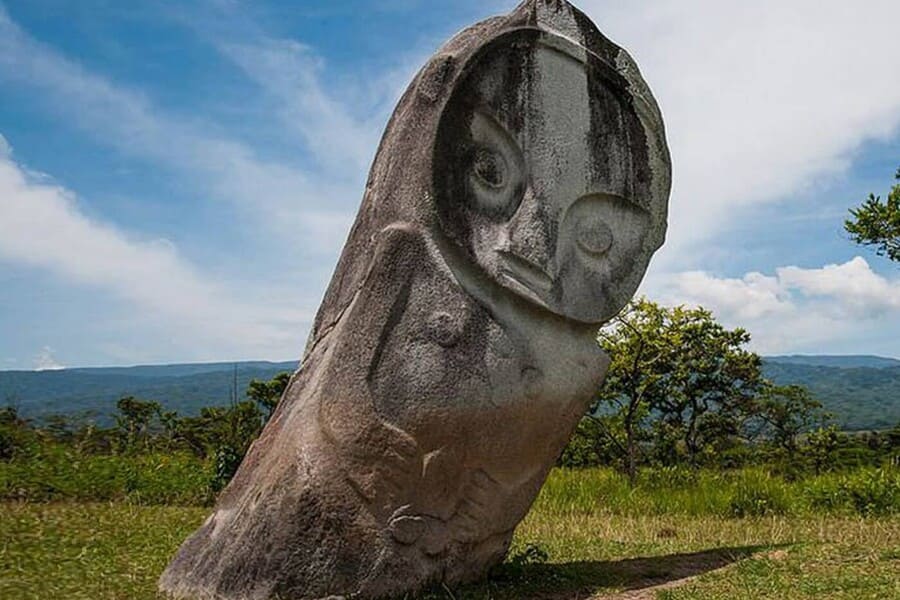
Tucked away in the highlands of Central Sulawesi, far from the well-worn paths of Bali or Yogyakarta, lies a landscape that few travelers ever see and even fewer fully understand. Bada Valley is home to one of Southeast Asia's most overlooked archaeological treasures: a scattered collection of massive stone statues whose age, purpose, and creators remain a genuine puzzle to archaeologists. For anyone planning an Indonesia tour that goes beyond beaches and temples, this remote valley offers something rare in modern travel, a destination where mystery is not a marketing gimmick but an honest, unresolved scientific question.
Having researched and reported on lesser-known archaeological sites across Southeast Asia, I find Bada Valley particularly compelling precisely because it resists easy answers. Unlike Borobudur or Angkor Wat, where inscriptions and historical records explain much of what visitors see, the megaliths here stand silent. No written records describe who carved them. This article walks through what is actually known, what remains speculation, and what a real visit to the valley involves.
What Is Bada Valley?
Bada Valley, sometimes referred to interchangeably with the neighboring Napu Valley in older texts, is a remote highland basin in Central Sulawesi, Indonesia, best known for housing dozens of carved stone monuments scattered across rice paddies, forest clearings, and grassy fields. Locals call these stones watu in the Badaic language, while in Indonesian they are known as arca, meaning statue.
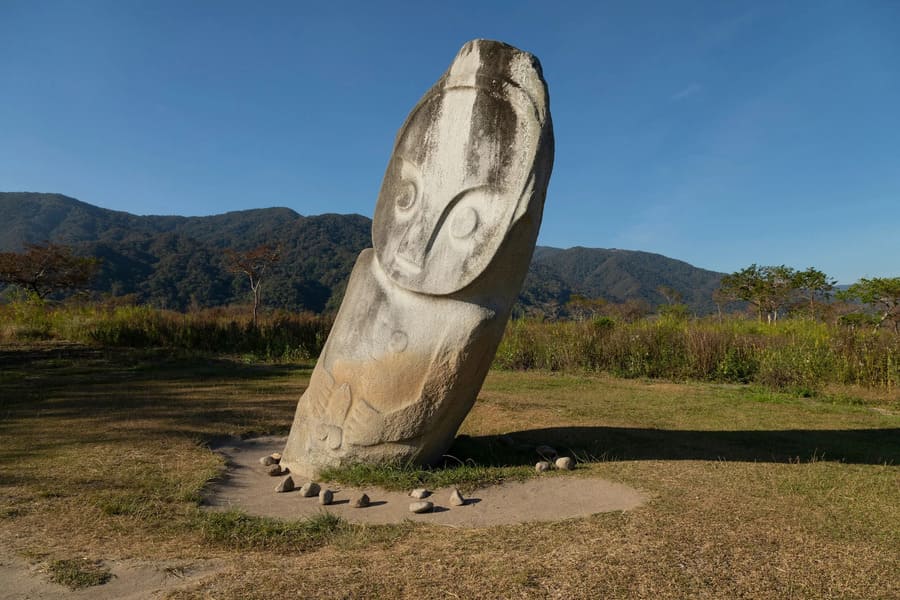
What makes Bada Valley Indonesia so significant to archaeologists is not a single monument but the sheer density and variety of stonework concentrated in one relatively small area. Researchers estimate bada valley megaliths number well over a thousand individual objects when smaller fragments, stone vats, and carved blocks are included, though the most striking and photographed pieces are the large anthropomorphic figures, human-like statues with simplified features, rounded eyes, and in many cases, clearly carved genitalia indicating gender.
These are not isolated curiosities. They form part of a wider megalithic complex spread across Lore Lindu National Park, which protects the valley along with its surrounding rainforest. In that sense, Bada Valley functions as the cultural heart of a much larger prehistoric landscape, one that archaeologists are still working to fully map and date.
Where Is Bada Valley Located?
Bada Valley in Central Sulawesi
Bada Valley sits within Lore Lindu National Park, a protected rainforest reserve in Central Sulawesi province that has also been recognized as part of the UNESCO World Network of Biosphere Reserves. The valley itself lies roughly 60 kilometers west of the lakeside town of Tentena, in a region of rolling hills, rice terraces, and small farming villages such as Bomba, Gintu, and Tuare.
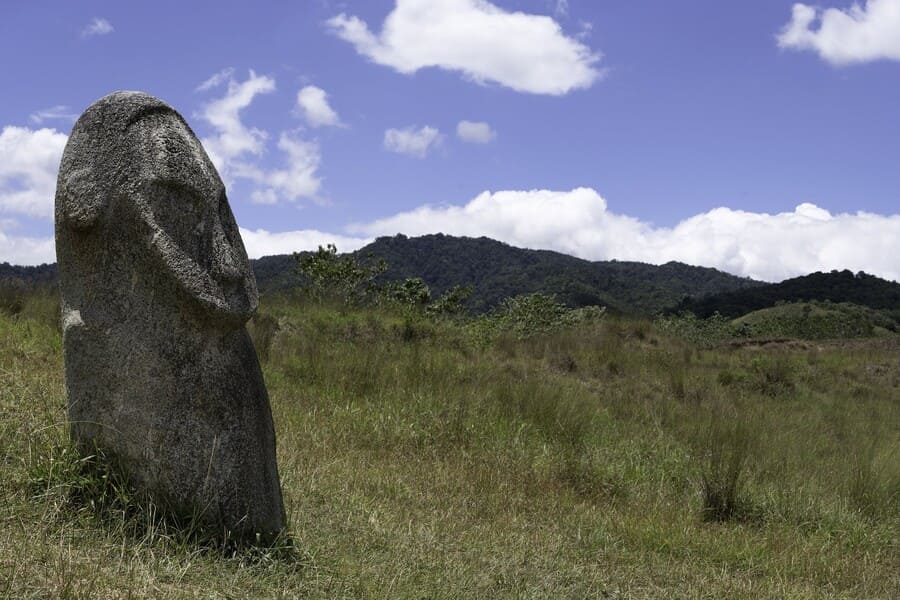
This part of Sulawesi is genuinely remote. There are no large resorts, no paved tourist circuits, and limited mobile signal in many stretches. That isolation is precisely why the megaliths survived largely undisturbed for centuries, and why the valley still feels authentic rather than curated for visitors.
How to Reach Bada Valley
Reaching Bada Valley requires patience and a degree of adventure, which is part of its appeal for serious travelers. Most journeys begin in Palu, the capital of Central Sulawesi, which has a domestic airport with connections from Jakarta, Surabaya, Makassar, and several other Indonesian cities.
From Palu, travelers typically continue by road to Tentena, a trip that can take seven to nine hours depending on road conditions. Many visitors break this journey by overnighting near Lake Poso, Indonesia's third-largest lake, before continuing toward the valley itself. From Tentena, the final leg to Bada Valley takes an additional several hours by 4WD vehicle, since the roads narrow and become unpaved closer to the valley.
A private car with an experienced local driver is strongly recommended over public transport for this final stretch, particularly after rainfall when the roads can become muddy and difficult to navigate. Travelers exploring the megaliths on foot should also expect to walk through wet rice fields to reach some of the more scattered statues, so packing a spare pair of shoes is a practical tip drawn from accounts of previous visitors. Hiring a local guide, ideally through the park's tourist office, is advisable both for navigation and for understanding the cultural context behind each statue, since many carry local legends that a guidebook simply cannot convey.
The Discovery of Bada Valley's Ancient Megaliths
Western awareness of these ancient megaliths in Indonesia dates back to 1908, when the statues were first formally documented during early colonial-era surveys of Central Sulawesi. For the local Bada, Napu, and Besoa communities, of course, the stones had never been "lost"; they were simply part of the landscape, woven into oral tradition long before any outside researcher arrived.
Since that initial documentation, the site has periodically attracted academic attention. A notable inventory conducted in 1994 by researchers associated with the Sagarmatha Faculty of Agriculture identified more than 300 distinct megalithic sites scattered across the broader Lore Lindu region, encompassing statues, stone vats known locally as kalamba, and carved mortars. This figure underscores that Bada Valley, while the most famous component, is really one piece of a much larger prehistoric puzzle stretching across the Bada, Besoa, and Napu valleys.
Unfortunately, not all of this heritage has been preserved responsibly. Some smaller relics have reportedly been removed from the area over the decades and traded outside Indonesia, which is one reason heritage advocates and Indonesian authorities have pushed for stronger protective measures and greater public awareness of the site's archaeological value.
Exploring the Giant Megaliths of Bada Valley
The Famous Palindo Statue
No discussion of indonesia giant megaliths is complete without Palindo, the undisputed centerpiece of Bada Valley. Standing approximately four meters tall, Palindo, whose name translates to "The Entertainer," is the largest known standing megalithic figure in the region and is located just south of the small village of Sepe.
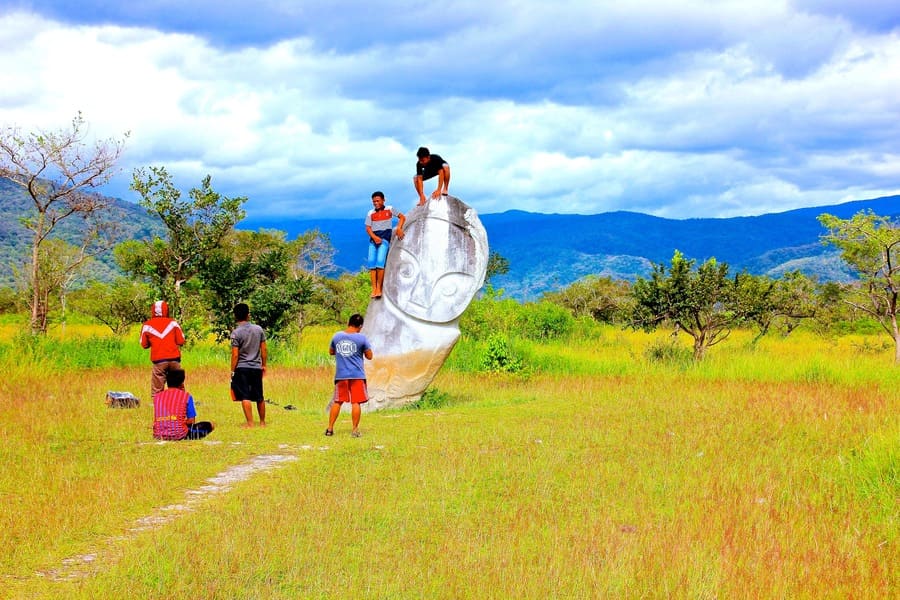
What strikes most visitors first is the statue's expressive face: large round eyes, a prominent nose, and a deeply carved mouth that gives it an almost cheerful, animated appearance, quite different from the stern or solemn expressions often associated with ancient monuments elsewhere in the world. Palindo is unmistakably male, with clearly carved genitalia, a feature shared by several other statues in the valley and one that local guides will point out as a deliberate, recurring element of the carving style rather than incidental damage.
Local folklore surrounding Palindo is rich and contradictory, which only adds to its mystique. One legend holds that a regional king, the Raja of Luwu, once ordered hundreds of subjects to physically relocate the statue southward to demonstrate his authority over the Bada people, an effort that reportedly failed. Another version of the story claims the statue originally faced south toward the king's territory before villagers turned it to face west as an act of defiance, and that the king's followers later died attempting to turn it back. Whether or not these tales reflect literal events, they reveal how deeply Palindo is embedded in local identity and memory, generations after its creation.
Other Mysterious Stone Figures
Beyond Palindo, the valley contains a remarkable diversity of carved figures, each with its own name, story, and physical quirks. Langke Bulawa, sometimes translated as "Queen with a Golden Leg" or "Golden Bracelet," depicts a female figure and stands in contrast to Palindo's robust masculinity, her face framed by what appears to be a carved fringe covering the forehead, a recurring gender marker found on female statues throughout the valley.
Other notable figures include Maturu, a reclining male statue measuring roughly three and a half meters in length, and smaller carvings such as Oba, a monkey-like figure standing in the middle of a rice field, whose exact subject, animal or child, remains debated among visitors and researchers alike. Stone vats known as kalamba, large carved basins whose function is still unclear, are scattered nearby and are often visited alongside the standing figures.
Each statue tends to carry its own local legend. Some are said to represent villagers transformed into stone as punishment for wrongdoing, others as guardians or ancestral spirits. While these stories should not be mistaken for verified history, they offer valuable insight into how local communities have made sense of these monuments across generations, and a knowledgeable guide can bring this oral tradition to life in a way that written sources cannot fully capture.
Theories Behind the Bada Valley Megaliths
Who Built These Ancient Monuments?
This is the question that has occupied archaeologists for over a century, and it remains genuinely unresolved. No inscriptions, written records, or definitive archaeological layers have been found that identify the builders of the megalithic statues of bada valley with certainty.
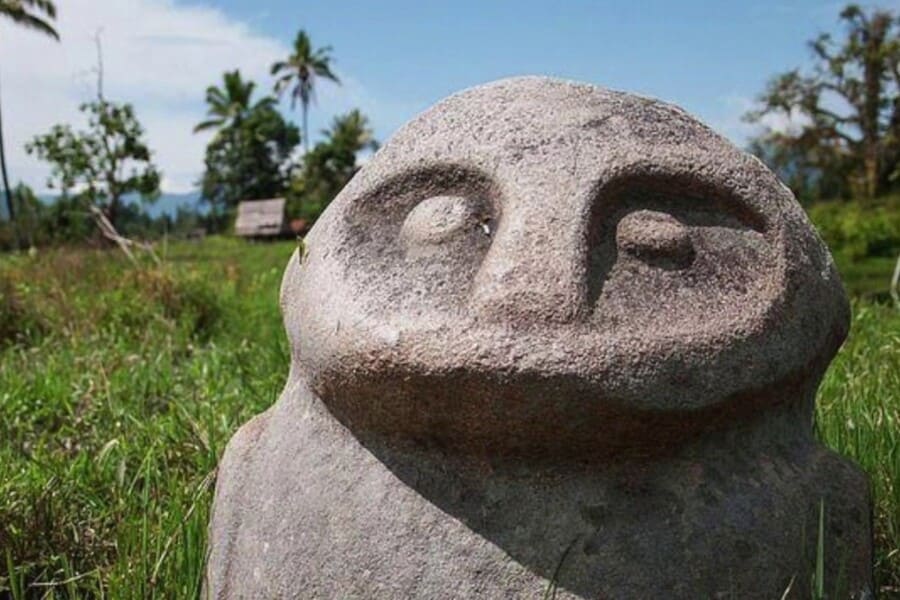
Dating estimates vary considerably depending on the source and methodology. Some researchers place the statues as far back as 3000 BC, while others argue for a more recent origin, suggesting the carvings date to around 1300 AD, making them, by some estimates, older than the famous Borobudur Temple in Java. This wide range itself reflects the genuine difficulty of dating stone monuments that lack organic material suitable for radiocarbon analysis, and reputable sources are careful to present these dates as estimates rather than settled fact.
Some scholars have noted stylistic similarities between the Bada Valley figures and megalithic traditions found elsewhere in the Asia-Pacific region, including parts of Laos and Cambodia, fueling speculation about possible cultural exchange across the wider Austronesian world. Others caution against drawing direct lines between geographically distant cultures without firmer evidence, noting that similar simplified, large-headed carving styles can emerge independently in different societies.
Religious and Ceremonial Interpretations
The most widely supported theory among archaeologists is that the statues served some form of ancestor veneration or ritual function, consistent with megalithic traditions documented elsewhere in Indonesia, including on islands such as Nias and in parts of Sumba. Under this interpretation, the statues may have represented important ancestors, clan founders, or spiritual guardians watching over agricultural communities.
The clear gender markers carved into many statues support theories connecting the monuments to fertility rites or ancestral lineage systems, where male and female figures may have symbolized complementary roles within a community's spiritual or social structure. However, it is worth being honest about the limits of this theory: it remains an informed interpretation based on comparative anthropology rather than a confirmed historical fact specific to the original Bada Valley builders.
Unanswered Archaeological Questions
Beyond questions of authorship and purpose, several practical mysteries persist. Researchers still debate why such enormous stones, some weighing many tons, were transported to their current locations without any clear evidence of the tools or techniques used. The absence of a written language associated with the builders means that any interpretation of symbolism or intent relies heavily on inference rather than direct testimony.
Ongoing looting and limited funding for systematic excavation have also slowed research progress. Heritage organizations have called for more rigorous, government-backed archaeological surveys of Lore Lindu National Park to properly catalogue, date, and protect the remaining megaliths before further pieces are lost or damaged.
Frequently Asked Questions About Bada Valley
How old are the Bada Valley megaliths?
Estimates vary widely among researchers, ranging from roughly 3000 BC to around 1300 AD. The lack of organic material for radiocarbon dating makes precise estimates difficult, and most credible sources present these figures as informed approximations rather than confirmed dates.
What is the most famous statue in Bada Valley?
Palindo, known as "The Entertainer," is the most famous and largest statue in the valley, standing approximately four meters tall near the village of Sepe. It is widely regarded as the signature monument among all the megalithic statues of bada valley.
Why are the Bada Valley megaliths mysterious?
The statues lack any accompanying written records, inscriptions, or confirmed historical documentation explaining who built them or why. Combined with uncertain dating and the absence of clear archaeological context, this leaves their purpose, builders, and exact age genuinely open questions rather than settled scholarly consensus.
Is Bada Valley worth visiting?
For travelers genuinely interested in archaeology, off-the-beaten-path destinations, and authentic rural Indonesian culture, yes. The journey is long and the infrastructure basic, but the reward is an intimate, largely uncommercialized encounter with one of Indonesia's most significant and least understood prehistoric sites, set within the scenic, biodiverse landscape of Lore Lindu National Park.